Treadmill repair starts with safe fault-finding: identify whether the issue is belt alignment, lubrication, power, motor load, controller fault, noise or deck wear. For most treadmill repair cases, an owner can check the safety key, plug, belt tension, belt centring and manufacturer-specified silicone lubrication before stopping work and calling a trained technician. This guide keeps the checks practical for Indian home users and gym owners.
Start With Safe Fault-Finding, Not Guesswork
Before touching anything, switch the treadmill off and unplug it. Do not open electrical parts if there is a burning smell, repeated tripping, visible wire damage, liquid entry, sparks, smoke, or an error code that returns immediately after restart. Those are stop signs, not DIY jobs.
For basic checks, keep the treadmill on a stable floor, remove dust around the belt edges, confirm that the safety key is seated, and check that the power socket is firm. If the machine is used in a gym, make sure users are not standing on the belt while starting at speed; that can feel like a treadmill motor fault even when the belt is simply overloaded at start-up.
For a broader preventive routine, use the maintenance checklist for gym equipment instead of relying on repair-only attention. Repair is reactive; maintenance is where many treadmill belt problems are caught early.
Quick Diagnosis Table for Common Treadmill Repair Symptoms
| Symptom | Likely cause | Safe owner check | Stop when |
|---|---|---|---|
| Belt slips | Loose belt, dry deck, worn belt | Check tension and lubrication | Slip continues after adjustment |
| Belt drifts | Rear roller misalignment | Centre belt slowly | Belt rubs side rail |
| Belt gets hot | Friction, dust, over-tension | Clean and use specified silicone | Heat returns quickly |
| Motor hums | Load, belt drag, controller issue | Run unloaded briefly | Smell or error appears |
| No power | Socket, switch, safety key | Check plug and key | Panel stays dead |
| Noise or vibration | Loose part, roller, deck wear | Check floor and belt path | Grinding or knocking continues |
Use the table as a filter, not a final verdict. Two faults often appear together: a dry belt can make the motor work harder, and a misaligned belt can heat at the edge. That is why treadmill repair should move from simple external checks to technician diagnosis only when the safe checks do not solve the symptom.
Treadmill Belt Problems: Slipping, Drifting and Replacement
Treadmill belt problems usually show up as slipping under foot, the belt moving to one side, black dust, squeaking, heat, or a jerky feel. Slipping can be caused by a loose belt, a dry deck, wear, or a drive belt issue inside the motor area. Drifting is usually alignment-related, but a stretched or damaged belt can also refuse to stay centred.
What can you safely check? First, look for debris between the belt and side rails. Second, centre the belt using the rear adjustment points in small equal movements. Third, check tension: the belt should not be so loose that it slips, and not so tight that it strains the treadmill motor. Overtightening is a common repair mistake.
Treadmill belt replacement is worth considering when the belt surface is cracked, frayed, glazed, repeatedly drifting, or heating even after correct lubrication and alignment. A replacement belt must match the treadmill model’s belt path and deck design; do not buy only by visual similarity. Running area is useful for user comfort, but it is not the same as the full belt size.
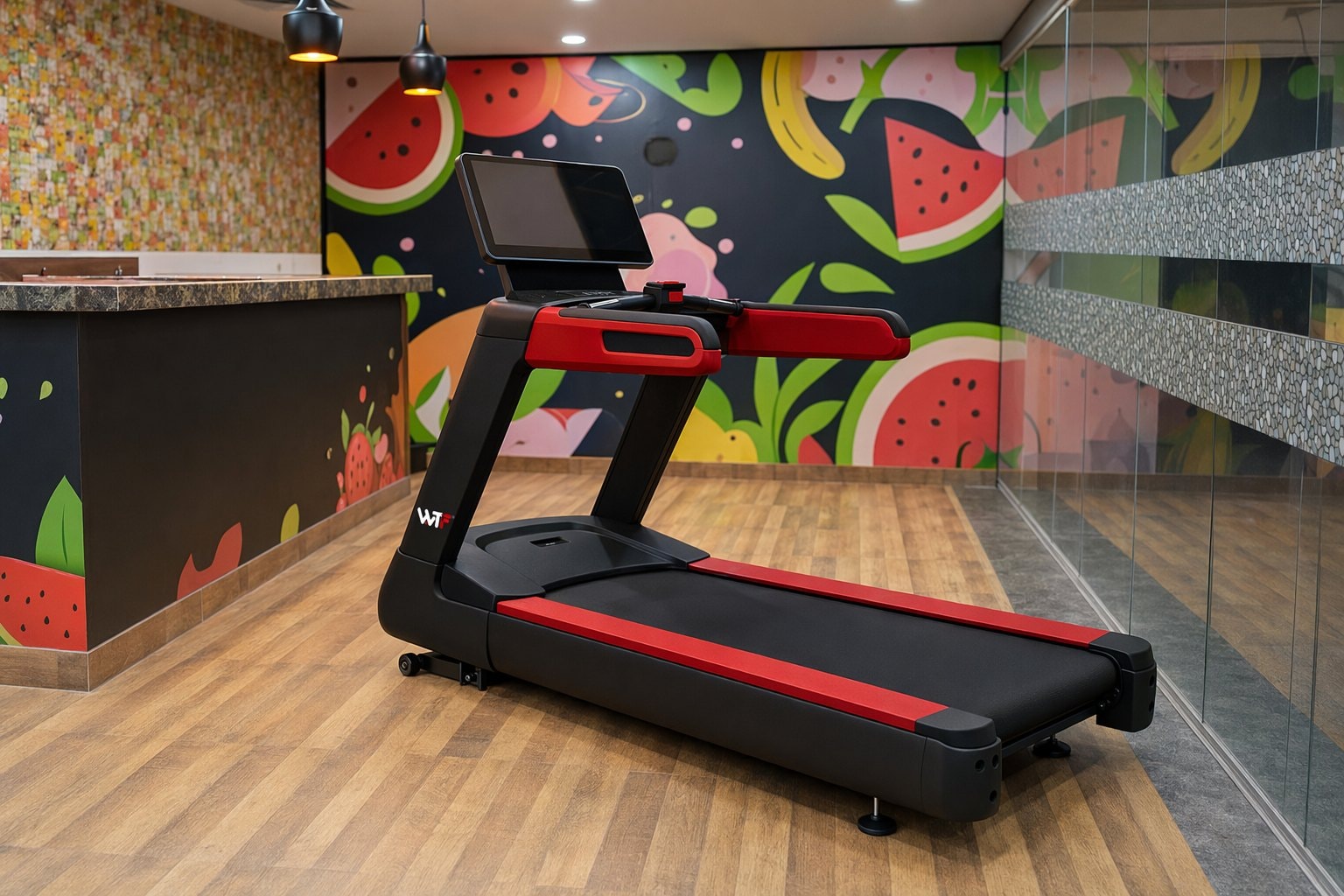
If you are comparing new options rather than repairing an old unit, note the listed running areas: the BEAST commercial treadmill has a 60x153cm running area, the DL800 commercial treadmill has a 55x166 cm running area, and the ONYX model has a 60x158cm running area. These are catalogue running-area figures, not belt replacement dimensions.
Lubrication: Belt Oil, Belt Spray and Alternatives
For lubrication, use the manufacturer-specified silicone product for the treadmill. Many buyers search for treadmill belt oil, treadmill belt spray or treadmill lubricant spray, but the label is less important than compatibility with the belt and deck. The wrong liquid can create slip, residue, belt swelling or extra dust capture.
A treadmill belt lubricant alternative is usually the wrong shortcut. Do not use cooking oil, grease, petroleum products or random workshop sprays. If the treadmill maker specifies silicone, use that type and apply it only as directed. Paisa vasool maintenance is not about using more lubricant; it is about using the correct lubricant in the correct place.
If the treadmill belt heating up problem returns after lubrication, look beyond the spray. The belt may be too tight, the deck may be worn, the belt underside may be damaged, or the motor may be working against excess drag. A treadmill belt getting hot is a warning sign; continuing long sessions can add load to the motor and controller.
Treadmill Motors Explained: What the Motor and Controller Do
Treadmill motors explained simply: the motor turns the front roller, the roller moves the belt, and the controller board manages speed, incline commands and load response. On motorized treadmills, the belt should move smoothly without surging, hesitation or burnt smell. If the belt is dry or overtightened, the motor has to work harder for the same user speed.
The catalogue’s Core commercial motorized treadmills list AC motors with 8 HP Peak (4HP Continuous) on models such as the Motorized Treadmill model 22, MT200A treadmill and FLEX commercial treadmill. For more detail on motor terms, use the treadmill motor HP guide.
Can a treadmill motor be repaired? Sometimes a trained technician can repair parts of the motor system, and sometimes the practical fix is replacement of the motor, controller board, wiring or related component. The right answer depends on diagnosis, part condition and whether the fault returns under load. Do not keep resetting a machine that trips or smells hot.
Non-motorized curved treadmills remove the treadmill motor from the equation, but they still have belts, bearings, resistance systems and decks to maintain. WTF lists the Curve non-motorized option with Nylon belt technology and the Curve Pro non-motorized treadmill with Aluminium belt technology; both list six levels of resistance and an innovative curved deck.
Power, Safety-Key, Error Code and Console Checks
When a treadmill is dead, start at the wall socket, plug, switch and safety key. A loose safety key can mimic a console fault. A weak connection can also cause intermittent shutdowns. Avoid extension boards that are loose, overheated or shared with heavy appliances; poor power quality can create confusing symptoms.
Error codes need the model’s manual or technician interpretation. An owner can note when the code appears: at power-on, during speed start, during incline movement, or after a few minutes of running. This timing helps separate belt drag, incline, sensor and controller issues. Do not open the controller area while the unit is connected to power.
If you are replacing instead of repairing, compare motorized, curved and other options in the cardio equipment range. Serious home buyers can also read the home treadmill buying guide, especially if the earlier treadmill failed because it was not suited to user weight or usage pattern.
Noise, Vibration, Deck Wear and Heat
Noise and vibration can come from the floor, belt path, roller, motor area, loose covers, deck wear or foreign objects. Start by checking whether the treadmill stands level and whether the belt is rubbing. A rhythmic thump often points toward the belt or roller path; grinding or scraping needs a technician check.
Deck wear increases friction. That can make the belt feel heavy, increase heat and make the treadmill motor sound strained. If cleaning, correct lubrication and alignment do not change the feel, stop using the machine. A worn deck and worn belt can damage each other, so replacing only one part may not solve the repair.
User weight also matters. Never select a treadmill rated exactly at the user’s weight; keep headroom between the user and the maximum rating. WTF catalogue models such as BEAST, DL800, MT200A and ONYX list Maximum User Weight: 200Kgs, while Curve lists Max User Weight: 150kg and Curve Pro lists Max User Weight: 180kg.
When Repair Is Sensible and When Replacement Is Cleaner
Repair is sensible when the issue is isolated: belt centring, lubrication, cleaning, a loose connection, a replaceable belt, or a diagnosed component. Replacement becomes cleaner when multiple major systems are tired together: belt, deck, motor load, controller behaviour and structural wear. Do not decide only from one symptom.
Duty tier affects how comfortably a treadmill handles repeated use. WTF’s relevant tier here is: “Core — full-commercial duty: cardio, selectorized, plate-loaded and functional lines rated for 16hr+/day floors, 7 days a week; 3mm steel main frames; continuous-duty AC motors on cardio (up to 5HP continuous).”
If you need a commercial replacement quote, WTF delivers and installs, provides a full GST invoice, and provides an itemised equipment quote within 24 hours. Buyers who want to see machines in person can visit the showroom at D-27, Sector 112, Noida, UP 201305; use the Noida showroom directions. For replacement budgeting, review the commercial treadmill price guide.