Commercial vs home gym equipment comes down to duty rating, build and user-weight rating. If the equipment will face many users, heavier lifters, long cardio sessions or a paid gym floor, choose commercial gym equipment; if it is for light personal use at home, home gym equipment can be enough. Seedhi baat: buy commercial where failure is costly or usage is unpredictable.
Start With Duty Rating, Not Just Size
The most common buying mistake is judging a machine by how large it looks in a photo. Commercial-grade design is about frame rigidity, rated user load, motor type, upholstery toughness, cable routing, bearing points, and checking how easily a technician can reach moving parts. A compact commercial machine can be more suitable for a gym floor than a bulky home machine if its duty rating matches the workload.
WTF uses C/P/S duty tiers so buyers can compare commercial, free-weight and flagship strength pieces; for the full framework, read the Core, Pro and Signature rating explainer before finalising a mixed gym order.
| Tier | WTF range wording | Typical fit |
|---|---|---|
| C | Commercial-use machines in WTF's range for high-traffic cardio and strength areas. | Shared cardio and strength zones |
| P | Club-duty free-weight pieces in WTF's range for repeated handling. | Free-weight zone |
| S | Flagship strength machines in WTF's range with the heaviest positioning. | Showpiece strength areas |
If you are buying for a commercial facility, keep the Core, Pro and Signature rating explainer open while shortlisting. If you are planning a serious residence setup, the home gym use-case page helps separate must-have machines from attractive but low-use additions.
Comparison by Machine Type
The table below compares the areas that matter most when choosing commercial-grade equipment for home or for a paid floor. Home gear can be useful, but it often works best around a known user group and lighter traffic. Commercial equipment is selected for unknown users, repeated adjustment, and practical checks such as whether a technician can reach moving parts when needed.
| Machine type | Commercial buying check | Home buying check | Where to spend more |
|---|---|---|---|
| Treadmill | Continuous-duty motor, deck, belt path, user-weight rating | Walking or short runs, space and noise | Motor and deck |
| Spin bike | Flywheel, belt drive, posts, sliders, user-weight rating | Comfort, adjustability, quiet riding | Drive system |
| Selectorized strength | Frame, weight stack, cable run, pulleys, shrouds | Exercise selection and footprint | Cable and stack feel |
| Plate-loaded strength | Frame, lever path, loading access, storage horns | Space and plate storage | Frame and movement path |
| Dumbbells | Drop tolerance, grip, rack fit, fast selection | Space-saving storage | Handle and locking design |
| Benches and racks | Stability, pad support, adjustment hardware | Exercise variety | Frame and adjustment points |
| Functional accessories | Finish, cleaning, repeated handling | Training style and storage | Contact surfaces |
Cardio: Motor, Drive And User-Weight Rating
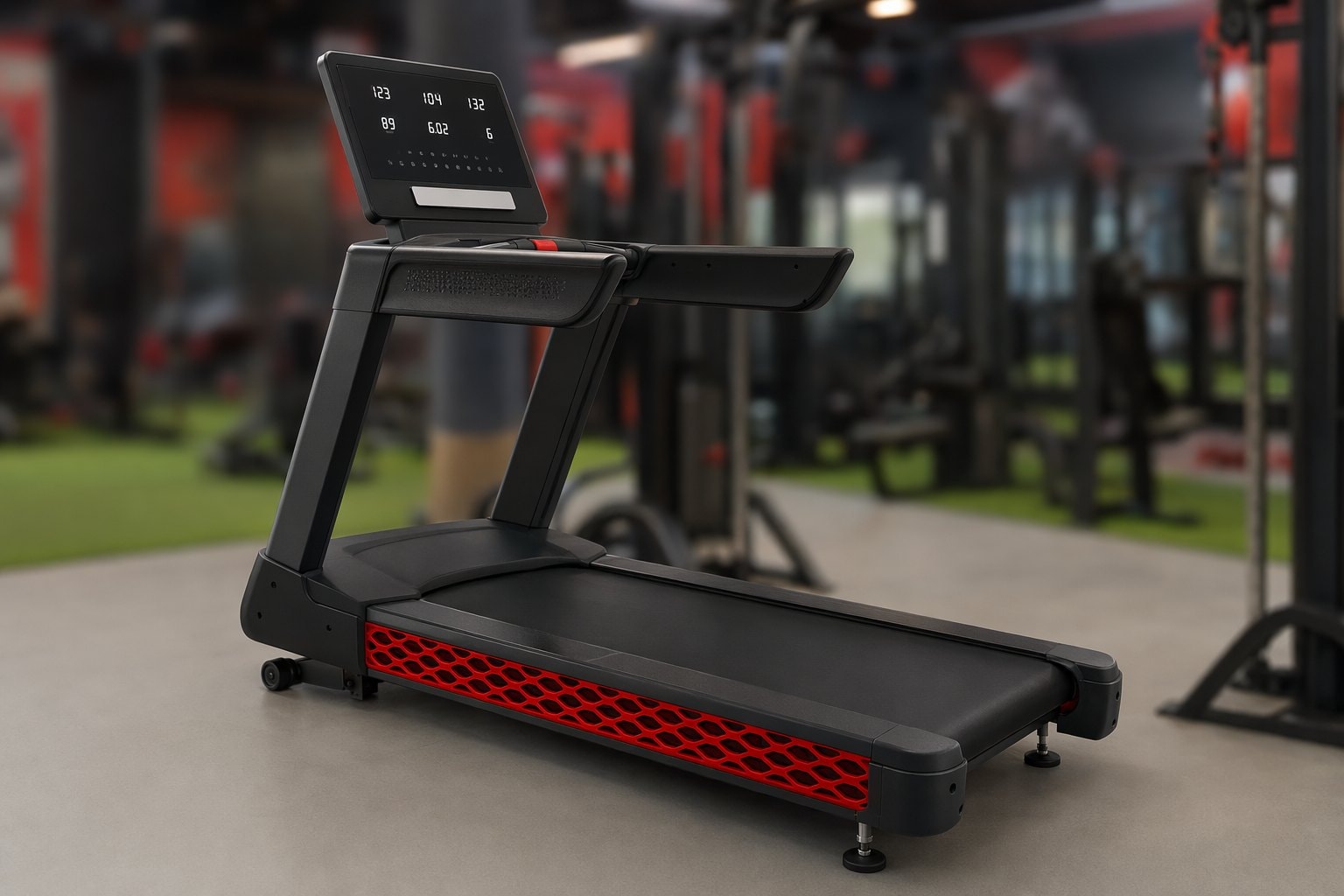
Cardio is where the difference between commercial and home equipment is easiest to feel. A home treadmill may advertise a peak motor figure, but commercial treadmill buying should focus on continuous output, deck build, running area, incline mechanism and user-weight headroom. Read the continuous figure first; WTF's own listings show it in brackets. Do not buy a treadmill rated exactly at the user's body weight; keep comfortable headroom so the machine is not always loaded at its limit.
In WTF's catalogue, the Motorized Treadmill model 22 is a C-duty machine with an AC motor rated at 8 HP peak, with 4 HP continuous shown in brackets. It lists a 1–24 km/h speed range, a 58 × 150 cm running area, 0–20% auto incline, 200 kg maximum user weight, an innovative cushioning system, a heavy-duty deck and 80 preset programs. The Commercial Motorized Treadmill BEAST is also C-duty, with an AC motor rated at 8 HP peak and 4 HP continuous, a 1–20 km/h speed range, a 60 × 153 cm running area, 0–20% auto incline, 200 kg maximum user weight, an innovative cushioning system, a heavy-duty deck and dimensions of 2,300 × 940 × 1,730 mm.
For bikes, check the drive system, adjustment posts, sliders and maximum user weight. The Commercial Spin Bike model 5917 lists a 25 kg flywheel, Poly-V belt drive, 180 kg maximum user weight, aluminium alloy posts and sliders, Made In India wording and dimensions of 1,164 × 617 × 1,250 mm. For gym owners comparing multiple cardio options, start with the cardio equipment category.
Home cardio gear is fine when one or two known users train moderately and can accept lighter construction. Commercial cardio makes more sense when user weights vary, the machine may run for long sessions, or the buyer wants a treadmill that is specified around continuous motor duty rather than headline peak power.
Strength Machines: Frames, Cables, Pulleys And Stacks
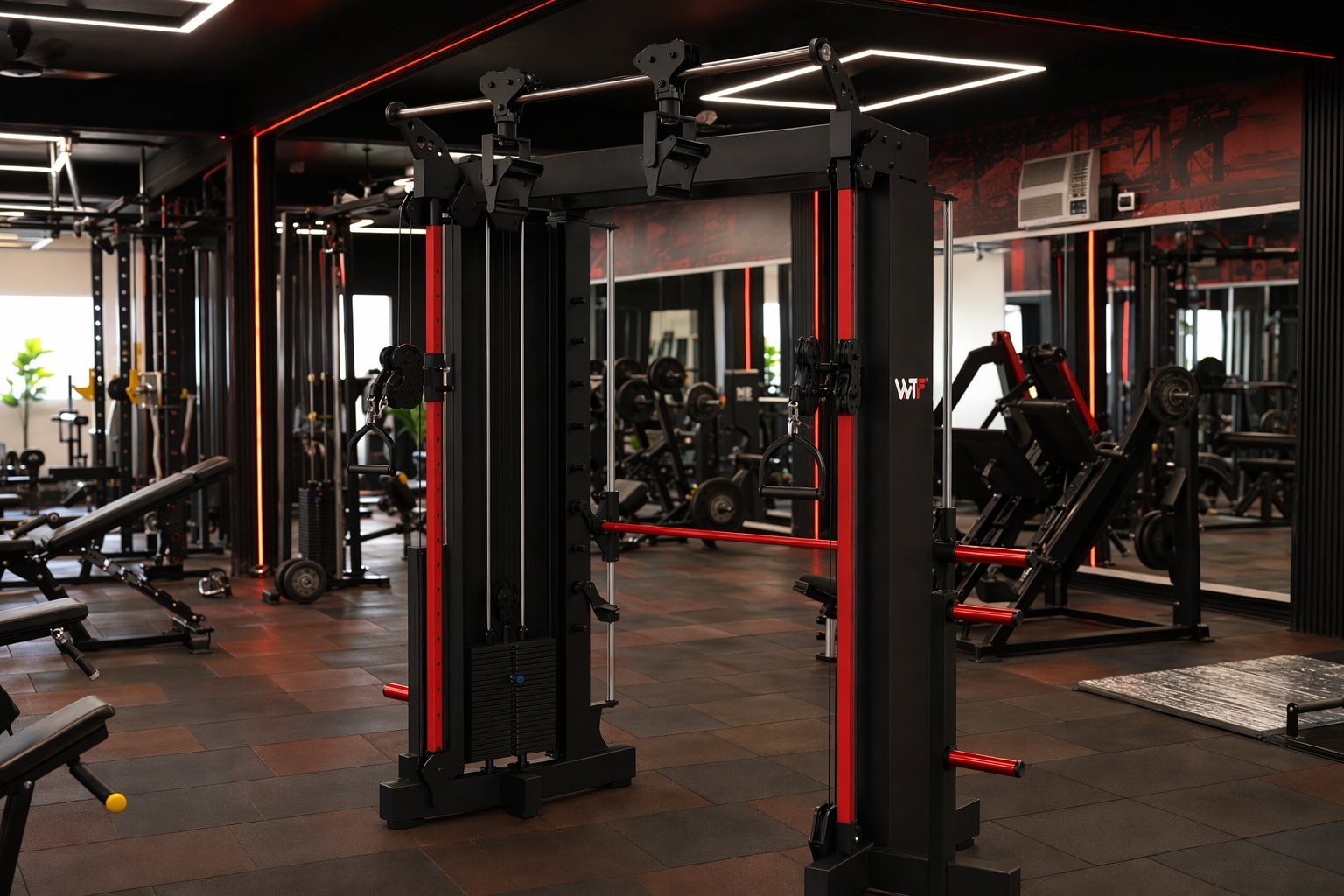
For selectorized strength machines, the frame is only the start. Cable routing, pulley alignment, weight-stack guide rods, selector pin feel, upholstery support and access panels affect daily use. Home multi-gyms can be adequate for controlled personal workouts, but on a shared floor the cable path and stack movement must stay smooth across many body types and adjustment habits.
The WTF Chest Press AMDM-01 is a C-duty selectorized-strength machine that measures 1,390 × 1,300 × 1,530 mm, has a 100 kg weight stack and is Made In India. The Leg Press AMDM-015 is C-duty, measures 1,985 × 1,035 × 1,530 mm, has a 100 kg weight stack and is Made In India. The Lat Pull Down AMDM-12 is C-duty, measures 1,340 × 1,365 × 2,290 mm, has a 100 kg weight stack and is Made In India. These are the kind of details a buyer should compare when planning selectorized zones; the full range sits under selectorized strength machines.
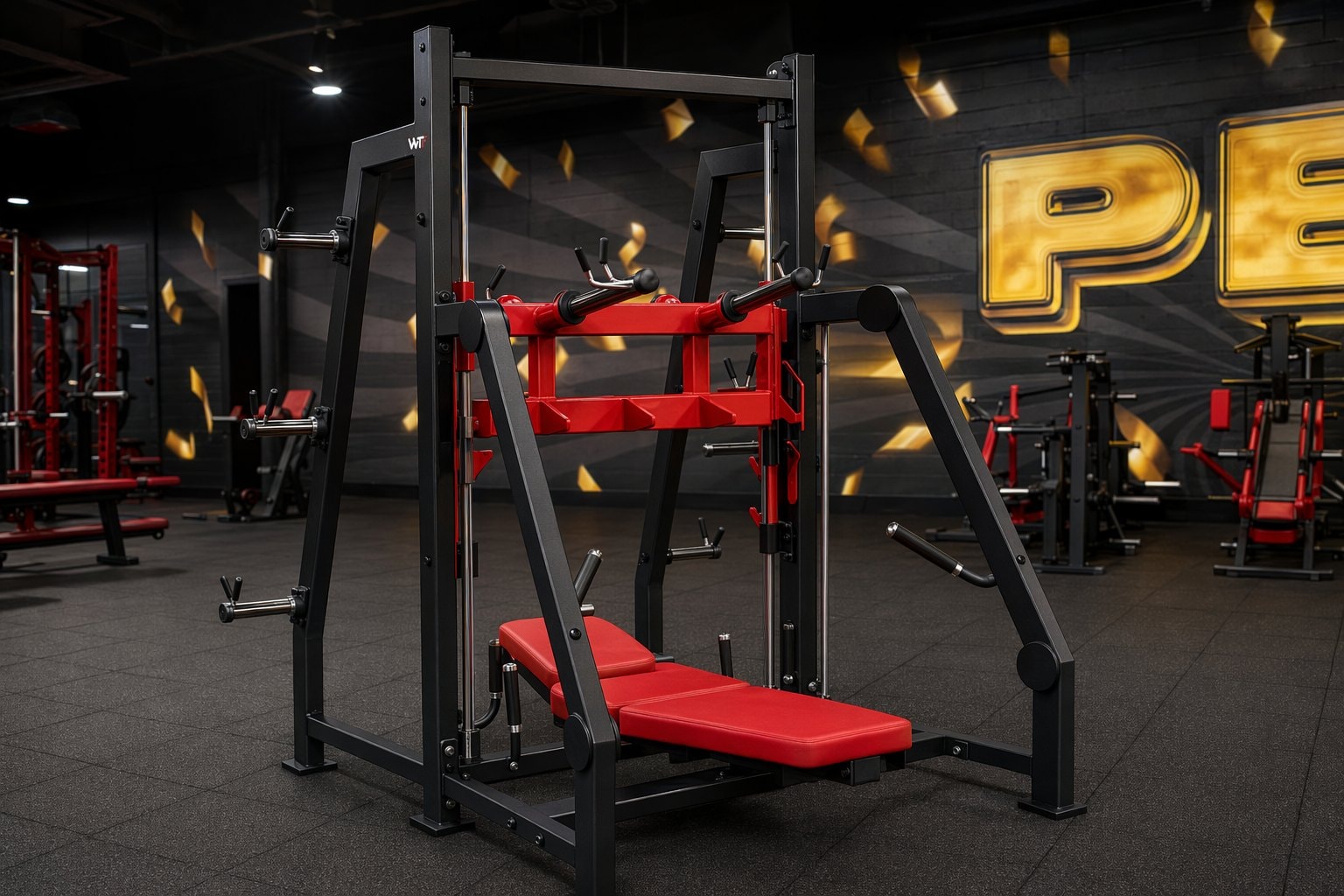
Plate-loaded strength is different. There is no weight stack, so the frame, lever path, starting position and plate-loading access become the main decision points. Plate-loaded machines suit lifters who want to choose their own load and a longer, heavier-feeling movement path. The Straight Line Chest Press A615 is S-duty with Heavy Duty Frame wording and Made In India wording. The Vertical Leg Press A616 is S-duty with Heavy Duty Frame wording and Made In India wording. In the AMV line, the Iso Lateral Chest Press AMV01, Iso Lateral Decline Chest Press AMV08, Iso Lateral Front Lat Pulldown AMV16, Lat Pull Down AMV27 and Chest Press & Lat Pull Down AMV28 list a black frame with red arms and Made In India wording.
Free Weights, Benches And Functional Pieces
Free weights take abuse differently from machines. Dumbbells, plates, bars, benches and racks are handled, dropped, re-racked and adjusted repeatedly. For a commercial floor, the main checks are grip comfort, secure adjustment, rack compatibility, bench pad support, frame stability and whether the item can tolerate rougher day-to-day handling.
The WTF Adjustable Dumbbells are P-duty and list commercial-grade materials and Made In India wording. For home buyers, adjustable dumbbells can be paisa vasool when space is tight and the training plan does not require a full dumbbell rack. For gyms, compare adjustment speed, user confusion, storage flow and how the dumbbell area will be supervised.
Benches deserve more attention than they usually get. The pad must support pressing, rowing and incline work without wobble. Adjustment hardware should feel positive, and the bench should not shift under normal setup. WTF's current MRP/list-price band from the adjustable bench price guide is ₹16,000–₹65,000 MRP.
Functional training pieces need a different lens. The Corrector (Pilates Spine Corrector Barrel) model CORRECTOR is C-duty and lists maple wood, 3.5 mm thickness, dimensions of 820 × 530 × 330 mm and Made In India wording. That kind of item is bought for specific programming, not because every gym needs one.
Price Bands: Compare By Category, Not Per Machine
Do not compare a home treadmill, a commercial treadmill and a club spin bike only by the lowest number you see online. Compare the duty rating, rated user weight, motor or drive system, technician access to moving parts and the machine's role in the facility. WTF publishes MRP/list-price bands in category price guides so buyers can plan a shortlist before requesting an itemised quote.
| Category | MRP/list-price band | Use this guide for |
|---|---|---|
| Commercial Treadmill | ₹48,500–₹2,59,500 MRP | treadmill price planning |
| Commercial Spin Bike | ₹38,500–₹74,000 MRP | spin bike price planning |
| Adjustable Bench | ₹16,000–₹65,000 MRP | bench price planning |
A home buyer can use these bands to decide where commercial duty is genuinely needed. A gym owner should use them to balance the floor: stronger cardio and core strength first, then specialised plate-loaded or functional pieces once the main movement patterns are covered.
When Commercial-Grade At Home Is Worth It
Commercial-grade at home is worth considering when the main user is heavy, trains hard, wants a stable strength station, or plans frequent treadmill running. It is also sensible when more than one family member will use the same equipment and adjust settings often. In these cases, the extra frame strength, continuous-duty motor choice, stronger drive system or cleaner weight-stack movement can make daily training feel more settled.
Home gear is fine when space is limited, workouts are occasional, loads are moderate and the user values fold-away convenience more than gym-floor durability. WTF's catalogue lists home-gym units such as the HG-666 Home Gym, but no foldable treadmill. For anything else, compare the commercial pieces actually listed.
For a paid gym, commercial gym equipment should be the default. For a serious apartment, bungalow or studio setup, mix intelligently: a C-duty treadmill, a strong bench, suitable dumbbells and one or two strength machines may be more useful than filling the room with machines that duplicate the same movement.
Buying Checklist For Indian Buyers
- Check duty rating first, then compare dimensions, weight stack, user-weight rating and movement path.
- For treadmills, read continuous motor output separately from peak motor wording.
- For spin bikes, compare drive system, flywheel, posts, sliders and rider weight headroom.
- For selectorized machines, inspect cable routing, pulley alignment, pin selection and stack movement.
- For plate-loaded machines, check lever path, starting position, loading access and floor space around the machine.
- For home setups, decide which pieces deserve commercial duty and which can stay simpler.
- Ask for a full GST invoice and an itemised quote within 24 hours before closing the order.
WTF delivers and installs equipment, and buyers can see the equipment range in person at the showroom at D-27, Sector 112, Noida, UP 201305. To compare a mixed order, request an itemised equipment quote and share the room size, user profile and training priorities.
The practical answer is not “commercial everywhere” or “home gear everywhere.” Choose commercial where the machine carries high load, many users or frequent adjustment; choose home equipment where usage is predictable and the cost of downtime is low.