Treadmill price in India depends less on one headline feature and more on motor duty, running area, incline, deck build, console and user-weight rating. WTF's price guide covers commercial treadmills only; the band starts at ₹48,500 MRP. For commercial treadmills in the WTF price guide, the current list-price band is ₹48,500–₹2,59,500 MRP. Seedhi baat: match the machine to walking, jogging or gym-floor running demand.
The Short Answer on Treadmill Price
For gym owners, the clean reference point is the commercial treadmill MRP band: ₹48,500–₹2,59,500 MRP. Treat this as a list-price band from our price guide, not as a per-product quote. The exact gym treadmill price depends on the model you choose, the required configuration, and the itemised quote.
For home buyers, this article does not invent a treadmill price for home use. Instead, compare home models by duty expectation: occasional walking, regular walking plus light jogging, heavier running, or a serious home gym setup. A low running machine price can be valid for light walking, but it may not suit heavier users, frequent running, or shared use by a family.
WTF runs 260+ gyms, so our buying advice is built around practical selection: choose enough motor capacity, enough belt space, and enough user-weight capacity before you look at console extras. WTF delivers and installs, provides a full GST invoice, and can share an itemised equipment quote within 24 hours.
What You Actually Pay For
The visible console often gets attention, but the treadmill price is usually shaped by the parts that carry load: motor, belt, deck, frame, incline mechanism and rollers. When comparing treadmill price in India, do not compare only peak HP or a big display photo. Compare the duty description and the running surface.
| Factor | Why it affects price | How to judge it |
|---|---|---|
| Motor duty | Continuous-duty motors are built for longer sessions | Check continuous HP, not only peak HP |
| Running area | Larger belts feel safer for longer strides | Match belt size to walking, jogging or running |
| Max user weight | Higher ratings need stronger structure | Compare the rating with expected users |
| Incline | Auto incline adds mechanism and training variety | Check range and smooth operation |
| Deck and cushioning | Deck build influences feel and load handling | Look for a heavy-duty deck on commercial units |
| Console | Programs and display features add convenience | Do not overpay for screens you will not use |
Home Treadmill Price vs Gym Treadmill Price
A home treadmill and a commercial gym treadmill may both say “motorized treadmill”, but they are bought for different workloads. A home machine can make sense for one or two users who walk or jog in controlled sessions. A commercial machine is chosen for repeated use, varied body weights, and members who may change speed and incline aggressively.
If your search is “treadmill for home price”, start by defining your use case. A walking-first home buyer can prioritise compactness, basic speed control and stable handrails. A serious home buyer should look closer at continuous motor rating, running area and maximum user-weight rating. If the home setup is part of a planned strength-and-cardio room, the home gym buying page can help you plan the mix without turning the treadmill into the only purchase.
For commercial buyers, the gym treadmill price must be judged as equipment for a cardio zone. WTF classifies cardio treadmills as Core-duty equipment; see the ratings page for how the tiering works. That duty tier is the main spec difference to compare against lighter units.
If you are choosing between a treadmill, bike and cross trainer for a gym layout, compare the full cardio equipment category rather than isolating a single machine. A treadmill carries higher impact and moving-belt demand than many cardio formats, so specification discipline matters.
Commercial Treadmill Models: Specs That Change Selection
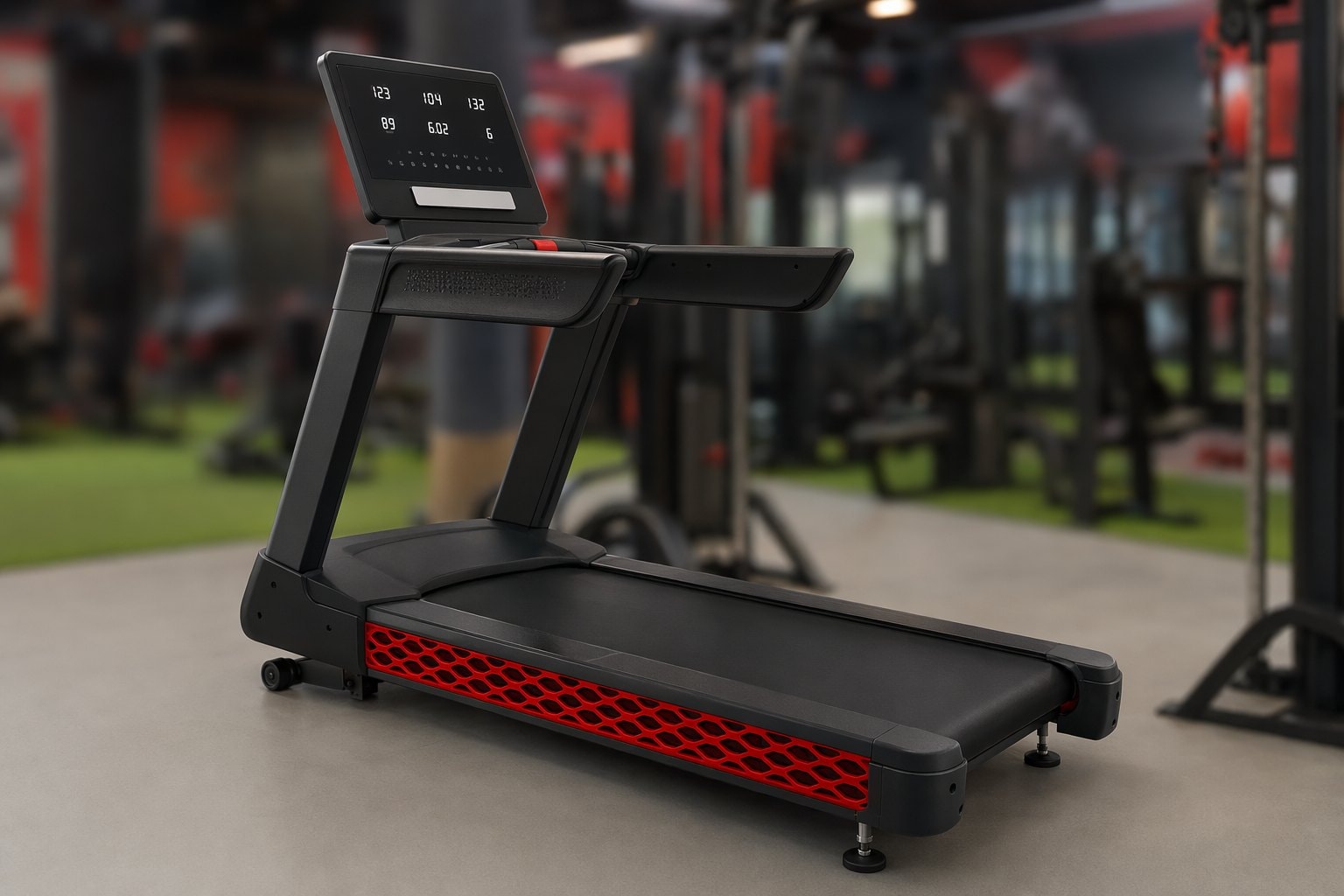
Within the commercial band, model selection should be driven by belt size, motor rating, incline range and user-weight requirement. The Model 22 motorized treadmill uses an AC motor rated at 8 HP peak and 4 HP continuous, with a 1–24 km/h speed range, 58 × 150 cm running area, 0–20% auto incline, 200 kg maximum user-weight rating, a heavy-duty deck and 80 preset programs.
Several WTF commercial motorized options use AC motors rated at 8 HP peak and 4 HP continuous, with a 200 kg maximum user-weight rating, but their belt dimensions differ. For example, the BEAST commercial treadmill lists a 60 × 153 cm running area, while the ONYX commercial treadmill lists 60 × 158 cm. The DL800 commercial treadmill lists 55 × 166 cm, which gives a different footprint feel for stride length.
| Model | Motor / type | Running area | Incline / resistance |
|---|---|---|---|
| Model 22 | 8 HP peak / 4 HP continuous | 58 × 150 cm | 0–20% auto incline |
| BEAST | 8 HP peak / 4 HP continuous | 60 × 153 cm | 0–20% auto incline |
| ONYX | 8 HP peak / 4 HP continuous | 60 × 158 cm | 0–20% auto incline |
| PHOENIX | 10 HP peak / 5 HP continuous | 60 × 168 cm | 0–15% auto incline |
| CURVE | Non-motorized treadmill | Curved deck | Six resistance levels |
| CURVE-PRO | Non-motorized treadmill | Curved deck | Six resistance levels |
The PHOENIX commercial treadmill is the clear spec step-up in WTF's range for motor rating. It uses an AC motor rated at 10 HP peak and 5 HP continuous, with a 60 × 168 cm running area, 0–15% auto incline, 200 kg maximum user-weight rating, a heavy-duty deck and dimensions of 260 × 100 × 185 cm. Choose that type of spec when the treadmill needs the longest belt and highest continuous motor rating in this range.
Motorized vs Curved Non-Motorized Treadmills
A motorized treadmill sets belt speed through the motor. It is easier to prescribe steady walking, jogging, incline intervals and controlled speed progressions. A curved non-motorized treadmill is user-driven; the runner controls pace by body position and effort. That changes the buying conversation from motor HP to belt technology, deck shape and resistance.
The CURVE non-motorized treadmill uses nylon belt technology, six resistance levels and an innovative curved deck, with a 150 kg maximum user-weight rating. Its display shows time, distance, speed, calories and pulse, and the model is Made in India. The CURVE-PRO non-motorized treadmill uses aluminium belt technology, the same six resistance levels and an innovative curved deck, with a 180 kg maximum user-weight rating. Its display also shows time, distance, speed, calories and pulse, and the model is Made in India.
For a gym, curved machines can add a different training station beside motorized units. For a home buyer, they suit users who are comfortable controlling pace without a powered belt. They are not a like-for-like replacement for every walking user, so compare training style before comparing price.
Why Very Low-Priced Treadmills Exist
Very low-priced treadmills are usually specced for light walking. Check continuous HP, running area and max user weight before trusting a low price. That does not make them useless; it means the buyer must not expect commercial behaviour from a compact home unit. Paisa vasool only happens when the use case is honest.
If a listing highlights only peak HP, ask for the continuous-duty rating. Peak HP is a short burst figure; continuous rating is more relevant to sustained use. If a listing hides running area, max user weight or deck description, treat that as a reason to ask questions. A bargain treadmill can become a poor fit if the belt is too short, the deck feels unstable, or the user weight is too close to the stated limit.
- For walking-only home use, prioritise stability, basic controls and enough belt width for a natural stride.
- For jogging, check continuous motor rating, deck feel, belt length and maximum user-weight rating.
- For running, avoid undersized belts and weak duty descriptions; speed range alone is not enough.
- For shared family use, choose around the heaviest regular user, not the lightest user.
- For gyms, compare full-commercial duty, running area and maximum user-weight rating before console extras.
How to Shortlist Without Overbuying
Start with the user and usage pattern, then move to the model. A walking user does not need the same machine as a gym where different members will sprint, walk at incline and adjust speed frequently. A serious home buyer may still choose a commercial treadmill if the household wants a heavier, roomier machine and has the space for it.
- Write down the heaviest regular user before checking model ratings.
- Decide whether the main use is walking, jogging, running, incline walking or mixed gym use.
- Check continuous motor HP on motorized treadmills; do not judge by peak HP alone.
- Compare running area dimensions against the user’s stride and confidence level.
- Check whether you need auto incline, manual effort on a curved treadmill, or both in a gym cardio zone.
- Confirm space, access path and installation location before finalising the quote.
If you are setting up a commercial cardio zone, read the dedicated gym treadmill selection guide alongside the price band. If you are buying for a flat, villa, office cabin or private training room, the home treadmill guide will keep the comparison focused on home-use realities rather than gym-floor assumptions.
Buying From WTF: Quote, Invoice and Showroom
WTF delivers and installs, and supplies a full GST invoice. For an exact commercial treadmill quote, ask for an itemised quote within 24 hours so you can see the model, quantity and line items clearly. This is better than comparing screenshots where specifications, tax treatment and installation scope may be unclear.
Buyers who want to see the equipment range in person can visit the WTF showroom at D-27, Sector 112, Noida, UP 201305. Use the Noida showroom page for location context before planning the visit.
For final selection, keep the decision simple: home walking, serious home running, commercial motorized treadmill, or curved non-motorized training. Once that is clear, the treadmill price discussion becomes practical instead of confusing.